Is the rule of law the best ally against poverty?
Where courts are reliable and property protected, there are far fewer poor people. It is one of the strongest links found between countries, but it runs mainly through wealth. And it is not the same thing as a small state.
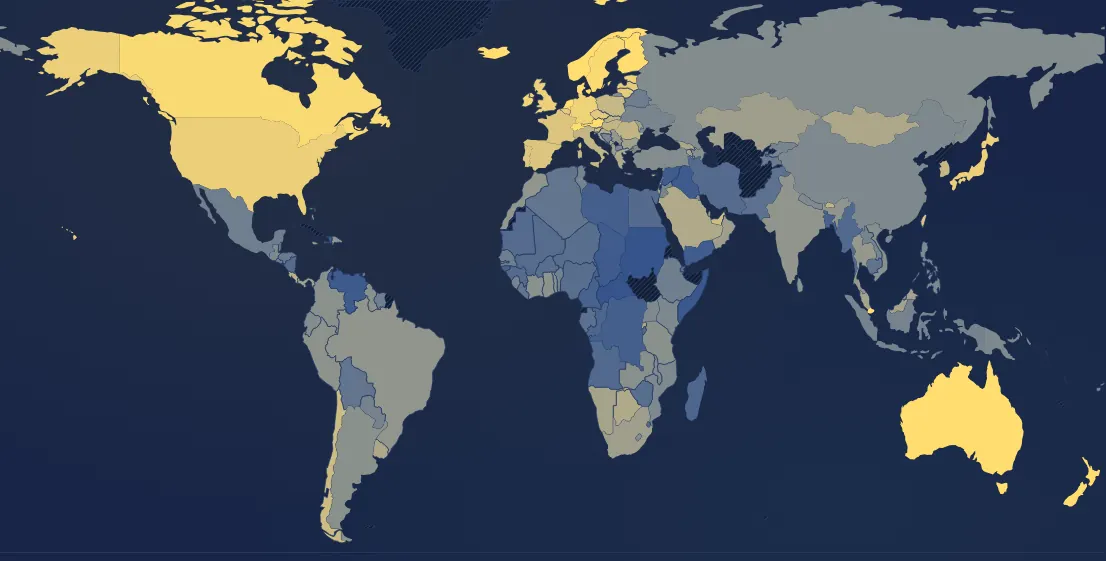
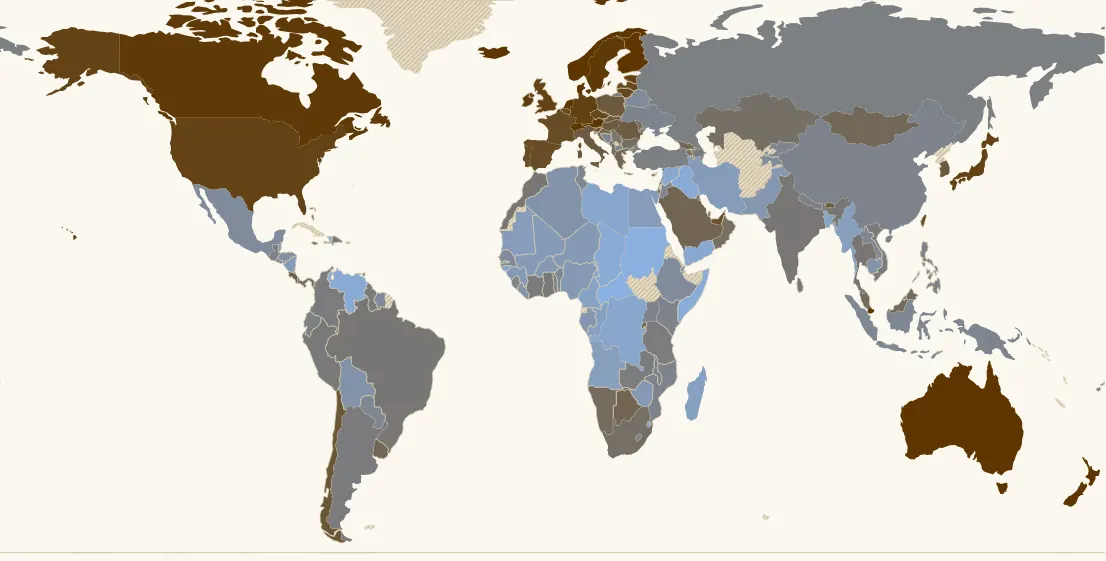
Every year the Fraser Institute rates countries' “economic freedom” from 0 to 10, in five areas: size of government, law and property rights, money, foreign trade, regulation. One of these areas stands out clearly when compared with poverty: law and property rights. It measures judicial independence, impartial courts, protection of property, enforcement of contracts, reliable police, and the absence of military interference in politics.
A very strong link
In 2021, across 86 countries, the higher the “law and property rights” score, the smaller the share of people living below 30 dollars a day, the poverty line the World Bank uses for rich countries (r ≈ −0.88). The link with political corruption as measured by V-Dem is almost as strong (r ≈ −0.85): where courts work, rulers embezzle less.
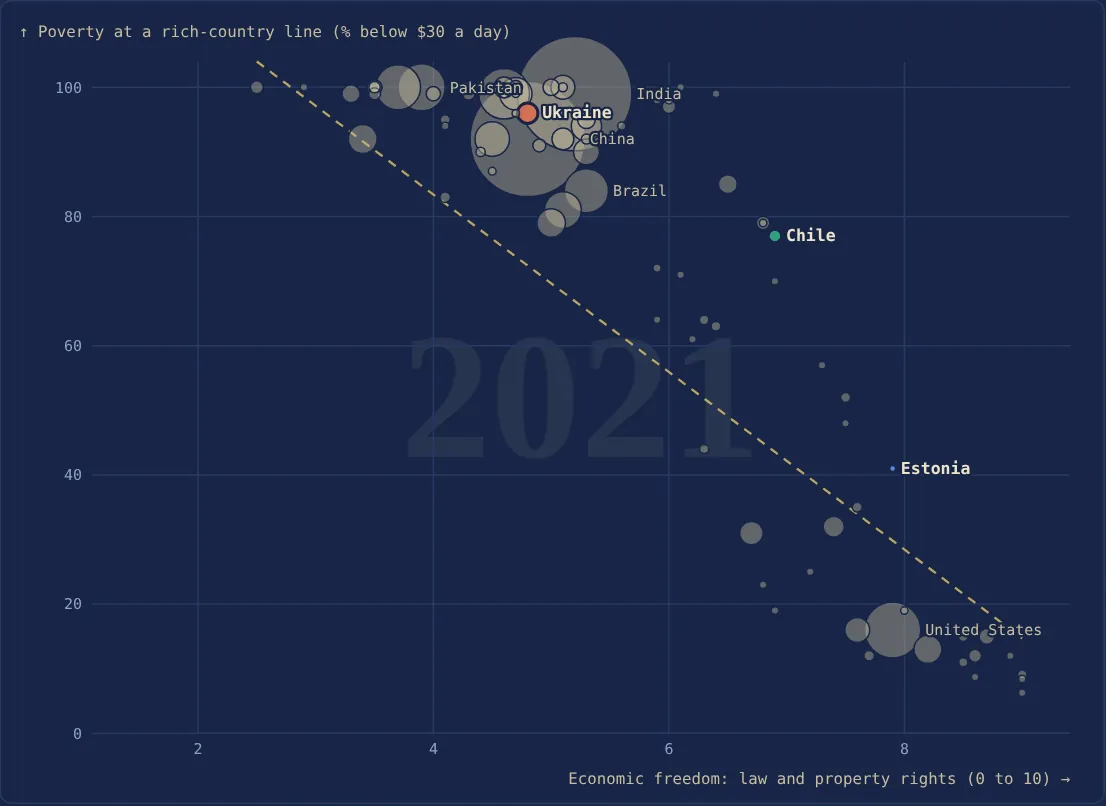
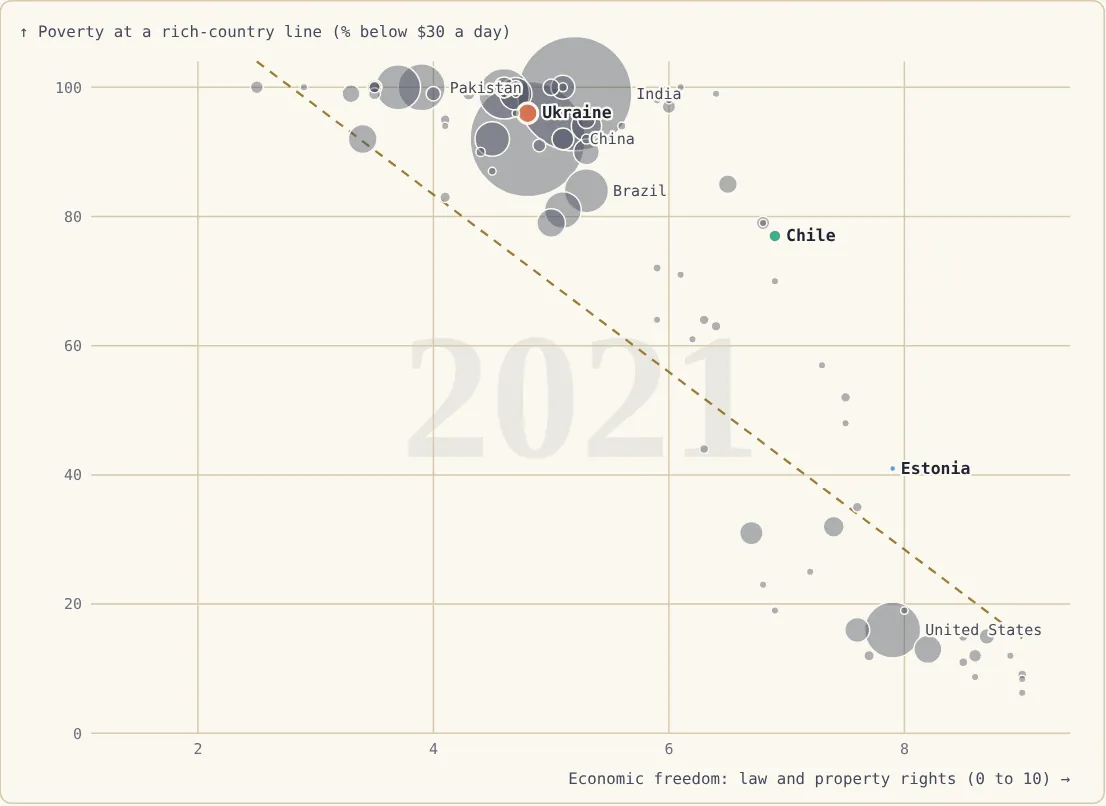
The best-rated countries are also those with the fewest poor people:
| Country | Law and property (0-10) | Below $30 a day |
|---|---|---|
| Norway | 8.9 | 6% |
| Denmark | 8.8 | 8% |
| Switzerland | 8.3 | 9% |
| France | 7.4 | 16% |
| Italy | 6.8 | 31% |
| Greece | 6.4 | 64% |
| Ukraine | 4.8 | 95% |
Three stories
Estonia and Ukraine both left the USSR in 1991. Estonia built strong institutions very fast: its score rose from 6.5 in 1995 to 7.7 in 2019, and corruption there became among the lowest in the world. Ukraine stayed around 4.8, undermined by corruption. In 1995 the average Estonian produced about 1.5 times as much as a Ukrainian; in 2019, 2.4 times as much. The share of Estonians below $30 a day fell from 94% to 41%, while it stayed around 95% in Ukraine.
Chile and Argentina, neighbours, had similar living standards. In 1995 Argentina was even richer. Chile kept reliable courts and a stable currency (score 7.0), while Argentina went through defaults and inflation, with less independent courts (5.5). By 2019 Chile had overtaken it in income per person, and the share of its population below $6.85 a day fell from 44% to 8%, against 13% in Argentina.
Georgia shows that a country can change fast. After 2004, a radical reform of the police and administration brought corruption down sharply (from 0.87 to 0.10 on V-Dem's scale between 2000 and 2010). GDP per person rose from about $5,800 in 2000 to $25,000 in 2024.
But the link runs mainly through wealth
These examples are telling, but they should be read with care. The rule of law goes hand in hand with wealth (r ≈ 0.77 with GDP per person), and wealth with little poverty. When countries of equal wealth are compared, the link with poverty below $6.85 a day almost disappears worldwide. Among rich countries, a clear part remains with the $30 line (about −0.55): at equal income, a country with reliable courts has fewer poor people.
Economists have long debated this. Douglass North, Nobel laureate in 1993, saw “institutions”, the rules of the game that protect property and contracts, as the key to development. Daron Acemoglu and James Robinson (Why Nations Fail, 2012; Nobel 2024 with Simon Johnson) showed that “inclusive” institutions, partly inherited from colonial history, explain much of today's wealth gaps. But causation also runs the other way: a country that grows rich can afford better judges and better-paid police.
There are exceptions too. Spain has a good score (7.6) but 32% of its population below $30 a day, because of long-lasting very high unemployment. Poland (6.6) grew rich very fast despite an average score.
Not the same thing as a small state
The Fraser index adds up very different things. The “size of government” area gives a better score to countries that spend, tax and redistribute little. Yet among rich countries this area goes the other way: countries with a small state tend to have more poor people (r ≈ +0.5). Denmark, Norway or Finland have a very large state and some of the best courts in the world; they are also the countries with the fewest poor people.
In other words, what the figures associate with low poverty is not the minimal state, but the state that obeys its own rules: independent judges, enforced contracts, little corruption. It is a point on which liberals and social democrats can agree.
Limits
Fraser and V-Dem scores rely partly on expert assessments, and the “law and property rights” area borrows some components from other databases (World Bank, World Economic Forum). Poverty lines come from income or consumption surveys carried out in different years depending on the country. And a correlation between countries does not prove that a judicial reform will on its own reduce poverty.
Sources
- Fraser Institute, Economic Freedom of the World (area 2, “Legal System and Property Rights”).
- World Bank, Poverty and Inequality Platform, via Our World in Data; Gapminder (GDP per person, extreme poverty).
- V-Dem, political corruption index.
- D. North, Institutions, Institutional Change and Economic Performance, 1990.
- D. Acemoglu, S. Johnson and J. Robinson, “The Colonial Origins of Comparative Development”, American Economic Review, 2001; D. Acemoglu and J. Robinson, Why Nations Fail, 2012.