Largest religion
The religion (or lack of one) with the most followers in each country. The chart and ranking give its share of the population.
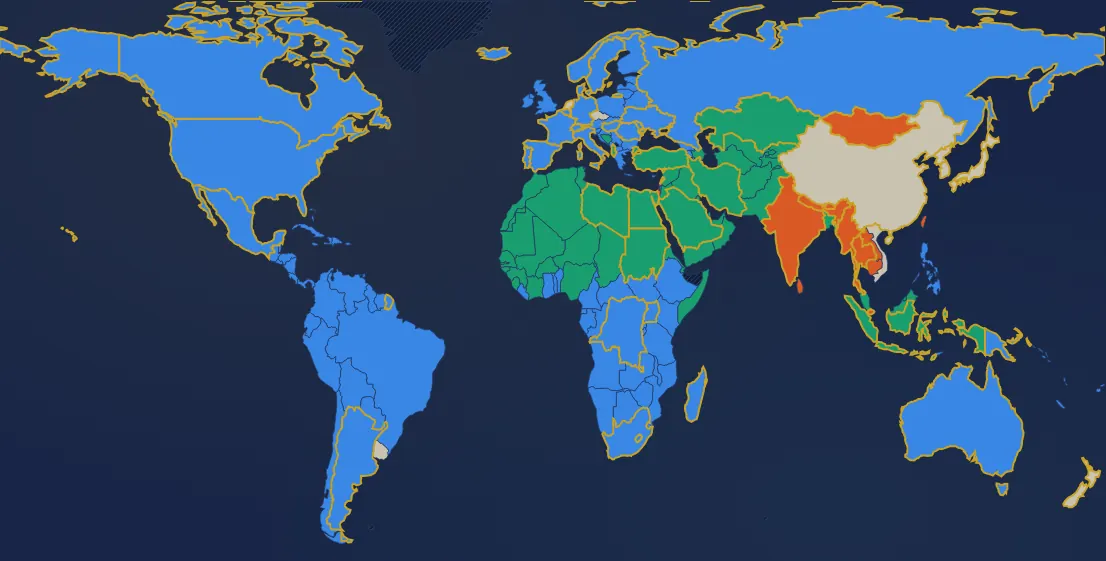
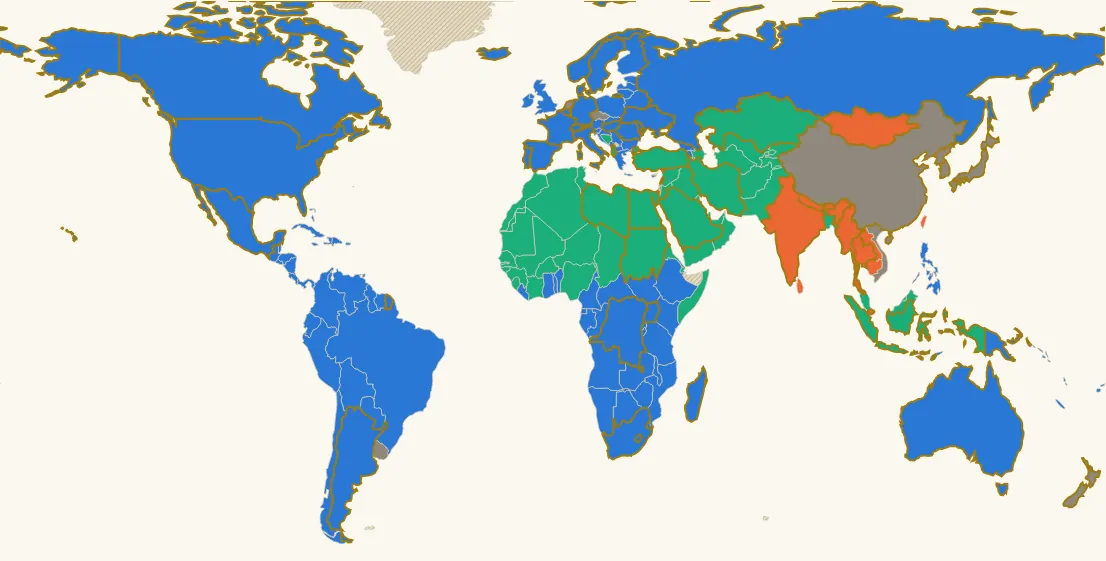
In 2020, 103 countries: Christianity; 49 countries: Islam; 12 countries: other religions; 9 countries: no religion.
Country ranking in 2020
| Country | Largest religion | % |
|---|---|---|
| Moldova | Christianity | 100 % |
| Timor-Leste | Christianity | 100 % |
| Papua New Guinea | Christianity | 99 % |
| Bahamas | Christianity | 98 % |
| Romania | Christianity | 98 % |
| Zambia | Christianity | 98 % |
| Armenia | Christianity | 97 % |
| Lesotho | Christianity | 97 % |
| Rwanda | Christianity | 97 % |
| Congo - Kinshasa | Christianity | 96 % |
| Burundi | Christianity | 95 % |
| Solomon Islands | Christianity | 95 % |
| Peru | Christianity | 94 % |
| Paraguay | Christianity | 94 % |
| Angola | Christianity | 93 % |
| Eswatini | Christianity | 93 % |
| Congo - Brazzaville | Christianity | 92 % |
| Guatemala | Christianity | 92 % |
| Lithuania | Christianity | 92 % |
| Philippines | Christianity | 92 % |
| Serbia | Christianity | 92 % |
| Central African Republic | Christianity | 91 % |
| Croatia | Christianity | 91 % |
| Panama | Christianity | 91 % |
| Poland | Christianity | 91 % |
| Greece | Christianity | 90 % |
| Namibia | Christianity | 90 % |
| Bolivia | Christianity | 89 % |
| Equatorial Guinea | Christianity | 89 % |
| Haiti | Christianity | 89 % |
| Mexico | Christianity | 89 % |
| Malta | Christianity | 89 % |
| Puerto Rico | Christianity | 89 % |
| Argentina its history → | Christianity | 88 % |
| Costa Rica | Christianity | 88 % |
| Ecuador | Christianity | 88 % |
| Georgia | Christianity | 88 % |
| Honduras | Christianity | 88 % |
| Uganda | Christianity | 88 % |
| Venezuela | Christianity | 88 % |
| Malawi | Christianity | 87 % |
| El Salvador | Christianity | 87 % |
| Zimbabwe | Christianity | 87 % |
| Colombia | Christianity | 86 % |
| Kenya | Christianity | 86 % |
| Belarus | Christianity | 85 % |
| Liberia | Christianity | 85 % |
| New Caledonia | Christianity | 85 % |
| Nicaragua | Christianity | 85 % |
| Portugal its history → | Christianity | 85 % |
| South Africa | Christianity | 85 % |
| Gabon | Christianity | 84 % |
| French Guiana | Christianity | 84 % |
| Vanuatu | Christianity | 84 % |
| Ukraine its history → | Christianity | 83 % |
| Botswana | Christianity | 82 % |
| Brazil | Christianity | 81 % |
| Ireland | Christianity | 81 % |
| Bulgaria | Christianity | 80 % |
| Italy | Christianity | 80 % |
| Dominican Republic | Christianity | 78 % |
| Denmark | Christianity | 77 % |
| Latvia | Christianity | 77 % |
| Montenegro | Christianity | 76 % |
| Iceland | Christianity | 75 % |
| Belize | Christianity | 74 % |
| Madagascar | Christianity | 74 % |
| Slovakia | Christianity | 74 % |
| Finland | Christianity | 72 % |
| Hungary its history → | Christianity | 72 % |
| Ghana | Christianity | 71 % |
| Norway | Christianity | 71 % |
| Cameroon | Christianity | 70 % |
| Spain its history → | Christianity | 70 % |
| Fiji | Christianity | 70 % |
| Russia | Christianity | 70 % |
| Trinidad & Tobago | Christianity | 70 % |
| Jamaica | Christianity | 69 % |
| Austria | Christianity | 68 % |
| Chile | Christianity | 68 % |
| Cyprus | Christianity | 68 % |
| Guyana | Christianity | 66 % |
| Luxembourg | Christianity | 66 % |
| North Macedonia | Christianity | 65 % |
| Slovenia | Christianity | 65 % |
| Tanzania | Christianity | 65 % |
| United States | Christianity | 64 % |
| Switzerland its history → | Christianity | 62 % |
| Ethiopia | Christianity | 62 % |
| Cuba | Christianity | 61 % |
| Mozambique | Christianity | 61 % |
| Sweden its history → | Christianity | 61 % |
| South Sudan | Christianity | 60 % |
| Togo | Christianity | 57 % |
| Germany its history → | Christianity | 56 % |
| Benin | Christianity | 53 % |
| Canada | Christianity | 53 % |
| Estonia | Christianity | 53 % |
| Suriname | Christianity | 53 % |
| Belgium | Christianity | 51 % |
| United Kingdom | Christianity | 49 % |
| Australia its history → | Christianity | 47 % |
| France its history → | Christianity | 46 % |
| Afghanistan | Islam | 100 % |
| Western Sahara | Islam | 100 % |
| Iran | Islam | 100 % |
| Iraq | Islam | 100 % |
| Morocco | Islam | 100 % |
| Somalia | Islam | 100 % |
| Yemen | Islam | 100 % |
| Libya | Islam | 99 % |
| Mauritania | Islam | 99 % |
| Palestine | Islam | 99 % |
| Sudan | Islam | 99 % |
| Tajikistan | Islam | 99 % |
| Tunisia | Islam | 99 % |
| Djibouti | Islam | 98 % |
| Algeria | Islam | 98 % |
| Niger | Islam | 98 % |
| Senegal | Islam | 98 % |
| Gambia | Islam | 97 % |
| Jordan | Islam | 97 % |
| Türkiye | Islam | 97 % |
| Pakistan | Islam | 96 % |
| Uzbekistan | Islam | 96 % |
| Azerbaijan | Islam | 95 % |
| Egypt | Islam | 95 % |
| Mali | Islam | 94 % |
| Syria | Islam | 94 % |
| Turkmenistan | Islam | 94 % |
| Saudi Arabia | Islam | 93 % |
| Kyrgyzstan | Islam | 92 % |
| Bangladesh | Islam | 91 % |
| Guinea | Islam | 87 % |
| Indonesia | Islam | 87 % |
| Brunei | Islam | 82 % |
| Oman | Islam | 82 % |
| Kuwait | Islam | 80 % |
| Sierra Leone | Islam | 80 % |
| Kazakhstan | Islam | 78 % |
| Qatar | Islam | 76 % |
| Albania | Islam | 74 % |
| United Arab Emirates | Islam | 73 % |
| Lebanon | Islam | 68 % |
| Burkina Faso | Islam | 67 % |
| Malaysia | Islam | 64 % |
| Guinea-Bissau | Islam | 56 % |
| Nigeria | Islam | 56 % |
| Chad | Islam | 56 % |
| Bosnia & Herzegovina | Islam | 54 % |
| Eritrea | Islam | 52 % |
| Côte d’Ivoire | Islam | 46 % |
| Cambodia | other religions | 97 % |
| Thailand | other religions | 94 % |
| Myanmar (Burma) | other religions | 89 % |
| Nepal | other religions | 81 % |
| India its history → | other religions | 79 % |
| Israel | other religions | 77 % |
| Bhutan | other religions | 75 % |
| Sri Lanka | other religions | 70 % |
| Laos | other religions | 64 % |
| Taiwan | other religions | 52 % |
| Mongolia | other religions | 51 % |
| Singapore | other religions | 31 % |
| China | no religion | 90 % |
| Czechia | no religion | 73 % |
| North Korea | no religion | 73 % |
| Vietnam | no religion | 68 % |
| Japan | no religion | 58 % |
| Netherlands its history → | no religion | 54 % |
| Uruguay | no religion | 52 % |
| New Zealand | no religion | 51 % |
| South Korea | no religion | 48 % |
5 countries or territories have no value that year.
Understanding this map
How to read the map
Only four colours, to stay readable: Christianity, Islam, other religions (Hinduism, Buddhism, Judaism, Shinto, Chinese or traditional religions…) and no religion. The tooltip says which and gives the full composition. “Largest” does not mean a majority: in Nigeria Islam comes first with about half the population, almost level with Christianity. People whose religion is “not stated” are not counted as a religion.
Limits
Counting religions is hard, and sources differ widely. The map's two series are therefore not joined end to end: from 2010 to 2015, the tooltip gives the other source's estimate. In China, the 1900-2015 series counts about 40% with no religion and a fifth following folk religions; Pew counts nearly 90%. In Estonia, 53% with no religion and 17% not stated on one side, 32% with no religion on the other. In Japan, many people belong to both Buddhism and Shinto without calling themselves religious. Before 1950, and in countries without a religious census, figures are reconstructions.
Sources : Religious Characteristics of States, Demographics v2.0 (Brown et James), via ARDA · 2010-2020: Pew Research Center, via Our World in Data
In the same theme : Religions
All maps
Page updated on 2026-11-03.