Women's right to vote
Can women vote in national elections, and on the same terms as men? The map also shows countries with no national elections, where nobody votes.
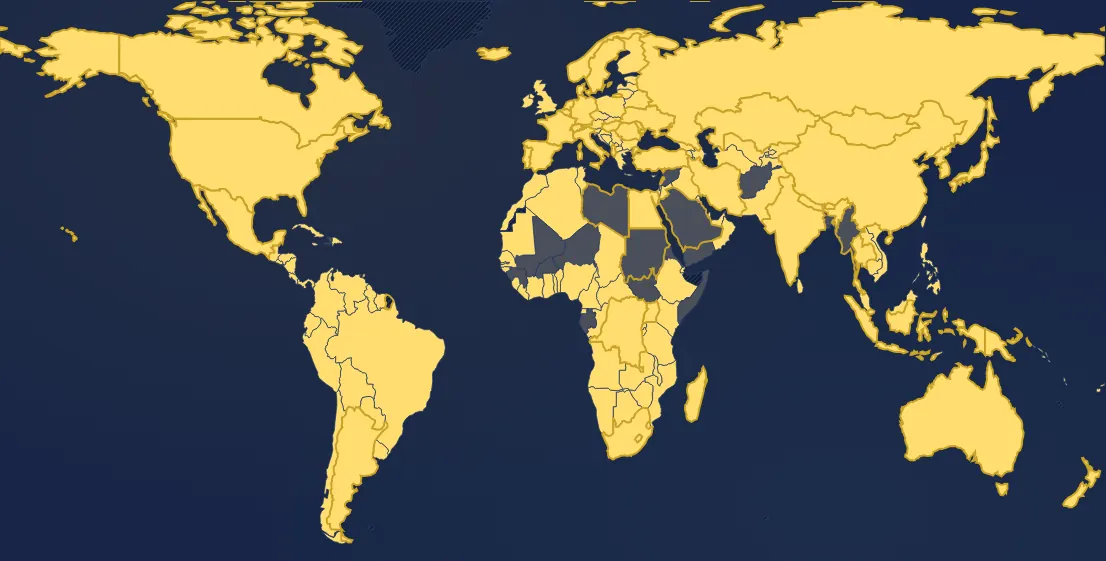
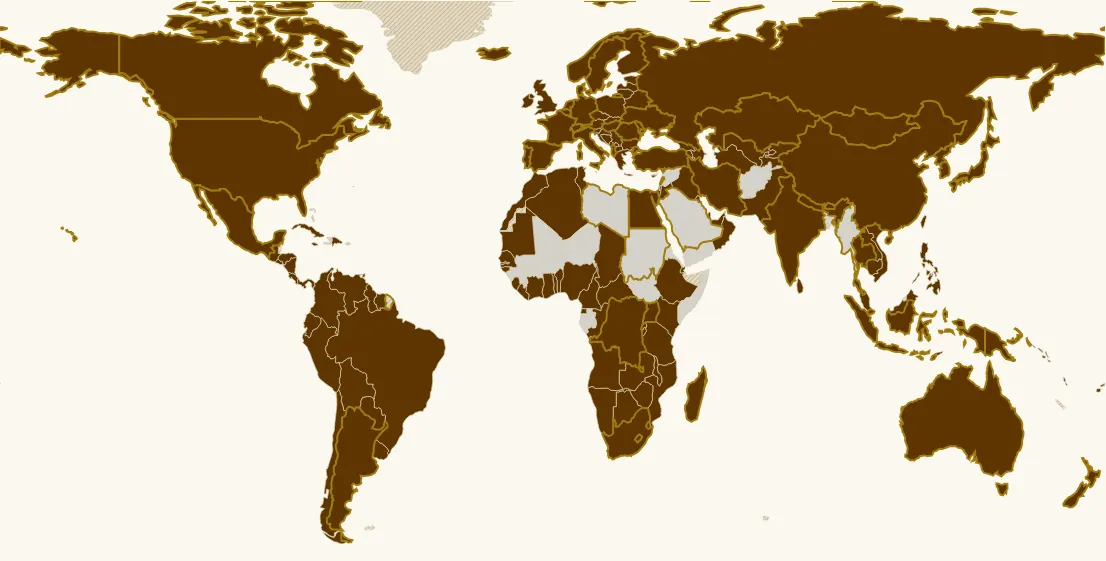
In 2025, 150 countries: same rights as men; 14 countries: no national elections.
Women's right to vote
| Country | Year | Women's right to vote (2025) |
|---|---|---|
| New Zealand | 1893 | same rights as men |
| Australia its history → | 1902 | same rights as men |
| Finland | 1907 | same rights as men |
| Norway | 1915 | same rights as men |
| Denmark | 1918 | same rights as men |
| Poland | 1918 | same rights as men |
| Austria | 1919 | same rights as men |
| Estonia | 1919 | same rights as men |
| Germany its history → | 1919 | same rights as men |
| Luxembourg | 1919 | same rights as men |
| Czechia | 1920 | same rights as men |
| Kenya | 1920 | same rights as men |
| Latvia | 1920 | same rights as men |
| Lithuania | 1920 | same rights as men |
| Russia | 1920 | same rights as men |
| United States | 1920 | same rights as men |
| Zimbabwe | 1920 | same rights as men |
| Albania | 1921 | same rights as men |
| Botswana | 1921 | same rights as men |
| Ireland | 1921 | same rights as men |
| Sweden its history → | 1921 | same rights as men |
| Netherlands its history → | 1922 | same rights as men |
| Myanmar (Burma) | 1923 | no national elections |
| Mongolia | 1924 | same rights as men |
| Trinidad & Tobago | 1925 | same rights as men |
| Namibia | 1926 | same rights as men |
| Zambia | 1926 | same rights as men |
| Iceland | 1927 | same rights as men |
| United Kingdom | 1929 | same rights as men |
| Guyana | 1930 | same rights as men |
| Ecuador | 1931 | same rights as men |
| Sri Lanka | 1931 | same rights as men |
| Brazil | 1933 | same rights as men |
| South Africa | 1933 | same rights as men |
| Spain its history → | 1933 | same rights as men |
| Thailand | 1933 | same rights as men |
| Portugal its history → | 1935 | same rights as men |
| Türkiye | 1935 | same rights as men |
| Cuba | 1936 | same rights as men |
| Philippines | 1938 | same rights as men |
| Uruguay | 1938 | same rights as men |
| Canada | 1940 | same rights as men |
| Dominican Republic | 1942 | same rights as men |
| Jamaica | 1944 | same rights as men |
| France its history → | 1945 | same rights as men |
| Hungary its history → | 1945 | same rights as men |
| Serbia | 1945 | same rights as men |
| Belgium | 1946 | same rights as men |
| Bulgaria | 1946 | same rights as men |
| Central African Republic | 1946 | same rights as men |
| Chad | 1946 | same rights as men |
| Côte d’Ivoire | 1946 | same rights as men |
| Djibouti | 1946 | same rights as men |
| Gabon | 1946 | no national elections |
| Guinea | 1946 | no national elections |
| Italy | 1946 | same rights as men |
| Mali | 1946 | no national elections |
| Mauritania | 1946 | same rights as men |
| Romania | 1946 | same rights as men |
| Senegal | 1946 | same rights as men |
| Togo | 1946 | same rights as men |
| Venezuela | 1946 | same rights as men |
| Benin | 1947 | same rights as men |
| Congo - Brazzaville | 1947 | same rights as men |
| Gambia | 1947 | same rights as men |
| Japan | 1947 | same rights as men |
| Madagascar | 1947 | same rights as men |
| Malta | 1947 | same rights as men |
| Niger | 1947 | no national elections |
| Burkina Faso | 1948 | no national elections |
| North Korea | 1948 | same rights as men |
| Singapore | 1948 | same rights as men |
| South Korea | 1948 | same rights as men |
| Chile | 1949 | same rights as men |
| Israel | 1949 | same rights as men |
| Panama | 1949 | same rights as men |
| Suriname | 1949 | same rights as men |
| Syria | 1949 | no national elections |
| El Salvador | 1950 | same rights as men |
| Argentina its history → | 1951 | same rights as men |
| Ghana | 1951 | same rights as men |
| Papua New Guinea | 1951 | same rights as men |
| India its history → | 1952 | same rights as men |
| Costa Rica | 1953 | same rights as men |
| Lebanon | 1953 | same rights as men |
| China | 1954 | same rights as men |
| Vietnam | 1954 | same rights as men |
| Malaysia | 1955 | same rights as men |
| Mexico | 1955 | same rights as men |
| Nicaragua | 1955 | same rights as men |
| Bolivia | 1956 | same rights as men |
| Egypt | 1956 | same rights as men |
| Greece | 1956 | same rights as men |
| Indonesia | 1956 | same rights as men |
| Peru | 1956 | same rights as men |
| Somalia | 1956 | no national elections |
| Tunisia | 1956 | same rights as men |
| Ethiopia | 1957 | same rights as men |
| Haiti | 1957 | no national elections |
| Honduras | 1957 | same rights as men |
| Cambodia | 1958 | same rights as men |
| Colombia | 1958 | same rights as men |
| Laos | 1958 | same rights as men |
| Uganda | 1958 | same rights as men |
| Liberia | 1959 | same rights as men |
| Tanzania | 1959 | same rights as men |
| Cyprus | 1960 | same rights as men |
| Pakistan | 1960 | same rights as men |
| Burundi | 1961 | same rights as men |
| Cameroon | 1961 | same rights as men |
| Malawi | 1961 | same rights as men |
| Rwanda | 1961 | same rights as men |
| Algeria | 1962 | same rights as men |
| Nepal | 1962 | same rights as men |
| Sierra Leone | 1962 | same rights as men |
| Morocco | 1963 | same rights as men |
| Paraguay | 1963 | same rights as men |
| Equatorial Guinea | 1964 | same rights as men |
| Eswatini | 1964 | same rights as men |
| Libya | 1964 | no national elections |
| Solomon Islands | 1964 | same rights as men |
| Afghanistan | 1965 | no national elections |
| Lesotho | 1965 | same rights as men |
| Sudan | 1965 | no national elections |
| Fiji | 1966 | same rights as men |
| Guatemala | 1966 | same rights as men |
| Congo - Kinshasa | 1970 | same rights as men |
| Switzerland its history → | 1971 | same rights as men |
| Guinea-Bissau | 1972 | same rights as men |
| Angola | 1973 | same rights as men |
| Bangladesh | 1973 | no national elections |
| Vanuatu | 1975 | same rights as men |
| Mozambique | 1977 | same rights as men |
| Nigeria | 1979 | same rights as men |
| Iran | 1980 | same rights as men |
| Iraq | 1980 | same rights as men |
| Jordan | 1989 | same rights as men |
| Slovenia | 1989 | same rights as men |
| Taiwan | 1989 | same rights as men |
| Armenia | 1990 | same rights as men |
| Azerbaijan | 1990 | same rights as men |
| Belarus | 1990 | same rights as men |
| Georgia | 1990 | same rights as men |
| Kazakhstan | 1990 | same rights as men |
| Kyrgyzstan | 1990 | same rights as men |
| Moldova | 1990 | same rights as men |
| Tajikistan | 1990 | same rights as men |
| Turkmenistan | 1990 | same rights as men |
| Ukraine its history → | 1990 | same rights as men |
| Uzbekistan | 1990 | same rights as men |
| Croatia | 1991 | same rights as men |
| North Macedonia | 1991 | same rights as men |
| Slovakia | 1993 | same rights as men |
| Yemen | 1993 | no national elections |
| Bosnia & Herzegovina | 1996 | same rights as men |
| Palestine | 1996 | same rights as men |
| Montenegro | 1998 | same rights as men |
| Oman | 1998 | same rights as men |
| Kosovo | 2002 | same rights as men |
| Timor-Leste | 2002 | same rights as men |
| Kuwait | 2005 | same rights as men |
| Bhutan | 2008 | same rights as men |
| United Arab Emirates | 2011 | same rights as men |
| Qatar | 2021 | same rights as men |
14 countries or territories have no value that year.
Understanding this map
What the map shows
Each year, each country falls into one of four cases, according to the V-Dem project: women vote on the same terms as men; only some women vote, or on stricter terms (in the United Kingdom from 1918 to 1928 a woman had to be 30, a man 21); women are excluded while men vote; or there are no national elections at all (dictatorship, war, occupation, colony), and nobody votes.
Not all men could vote either
Before 1914 male suffrage was often restricted: you had to pay enough tax, own property, be literate or have a fixed address, which mostly excluded workers, servants and poor peasants. Around 1900 only 60% of adult men voted in the United Kingdom, 25% in Sweden and Italy, 5% in Japan. France stood out with universal male suffrage from 1848. The map compares women with men; the tooltip gives the actual share of adult women and men who can vote.
“Same rights” does not mean “everyone votes”
The criterion compares women with men. In segregated South Africa, white women vote from 1933 like white men, but the black majority, men and women, stays excluded until 1994: so the tooltip also gives the share of adult women who can vote (20% in 1933). In the United States, Southern laws keep many Black citizens from voting until the 1960s. And voting does not mean choosing freely: that is what the democracy index measures.
The dates
New Zealand is the first country where women vote (1893), followed by Australia (1902) and Finland (1906, first vote in 1907). In France the ordinance dates from April 1944 and women first vote in 1945; in Switzerland in 1971 at federal level. V-Dem generally records the year the right is first applied, which can differ by a year or two from the law. For countries whose series starts at independence with the right already granted (former USSR, former Yugoslavia, Poland, Israel…), the actual year is not known here: they are left out of the ranking.
The chart
It gives the share of adult women who have the right to vote, country by country, and as a population-weighted average for the world and the continents. Countries with no national elections that year are not counted: otherwise the curve would drop at every coup or suspension of elections (in China during the Cultural Revolution, for instance).
Limits
Only national elections count: Saudi women voted for the first time in 2015, in municipal elections, but Saudi Arabia still has no national elections. These are expert assessments based on electoral laws; a colony is rated on the elections actually held there. Data start in 1900.
Sources : V-Dem, jeu de données v16 (2026)
In the same theme : Democracy
All maps
Page updated on 2026-11-03.